By Marsel Shiriiazdanov
SEATTLE, WA — Ahead of the 2026 FIFA World Cup, downtown Seattle has been transformed into an expansive, open-air augmented reality (AR) gallery. On Tuesday, June 23, 2026, the formal opening ceremony for this cutting-edge exhibition took place beneath the iconic Pacific Science Center Arches. Organized by Future Arts—a local arts nonprofit—the event brought together artists, organizers, and guests to celebrate a project that has been years in the making.
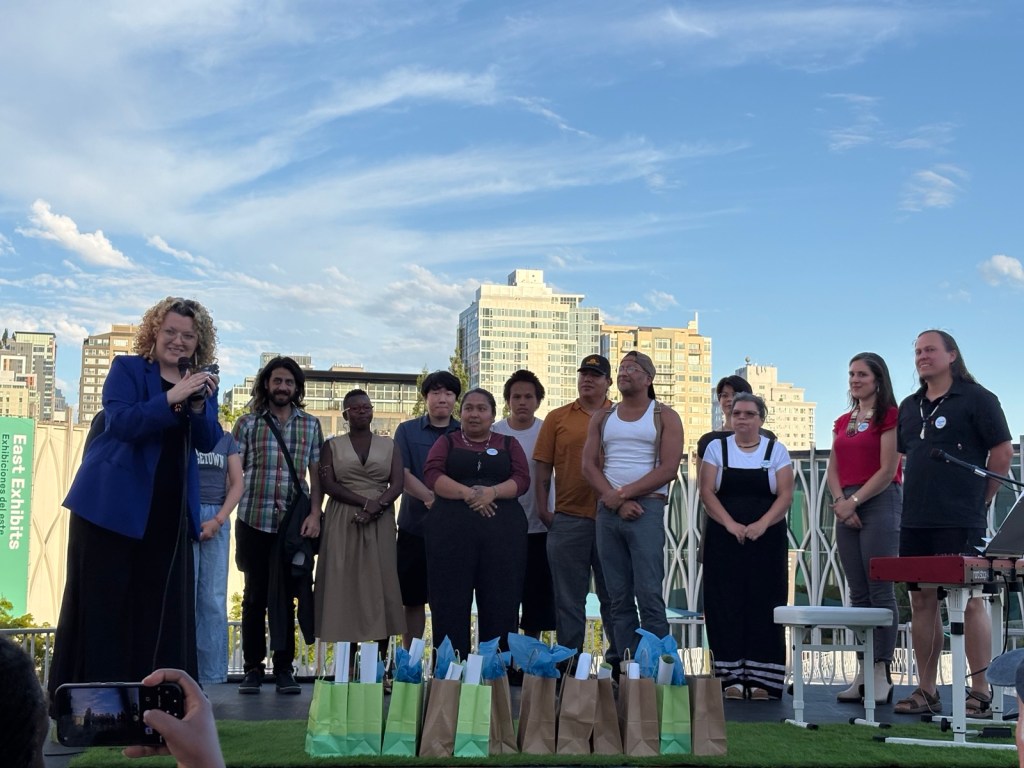
“It has been more than four years in the making,” remarked Yuliya Bruk, the executive director of Future Arts, during her opening statements. In a rare turn of events for an art gallery opening, Bruk enthusiastically urged attendees to keep their smartphones out, noting that the exhibition’s vibrant, multi-layered artwork only truly comes alive when viewed through a digital screen.
The centerpiece of this interactive experience is Future Arts Way, a 2.5-mile AR trail weaving through the heart of downtown Seattle. Following the opening remarks, we sat down with featured artist Alex Kosnett to discuss Latent Seas / Latencies, an immersive AR installation they co-created with collaborator Alina Nazmeeva.
Redefining the Boundaries of Nature and Art
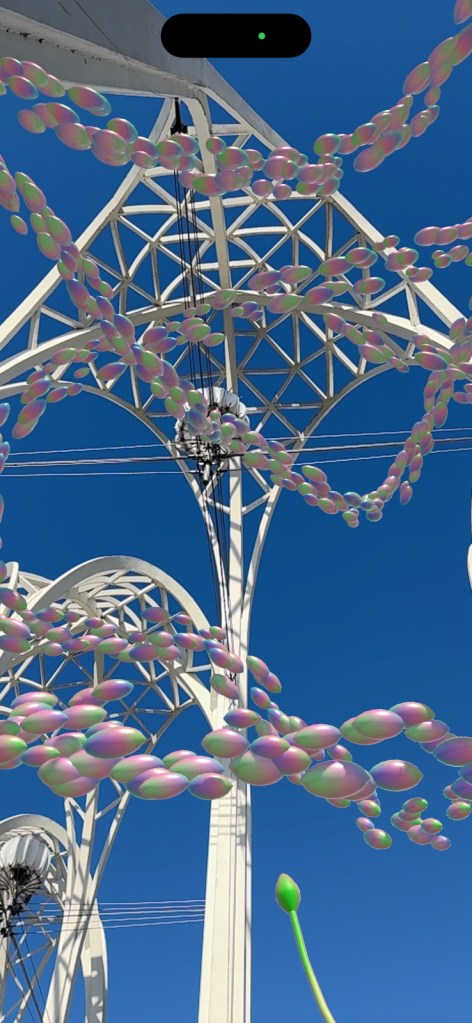
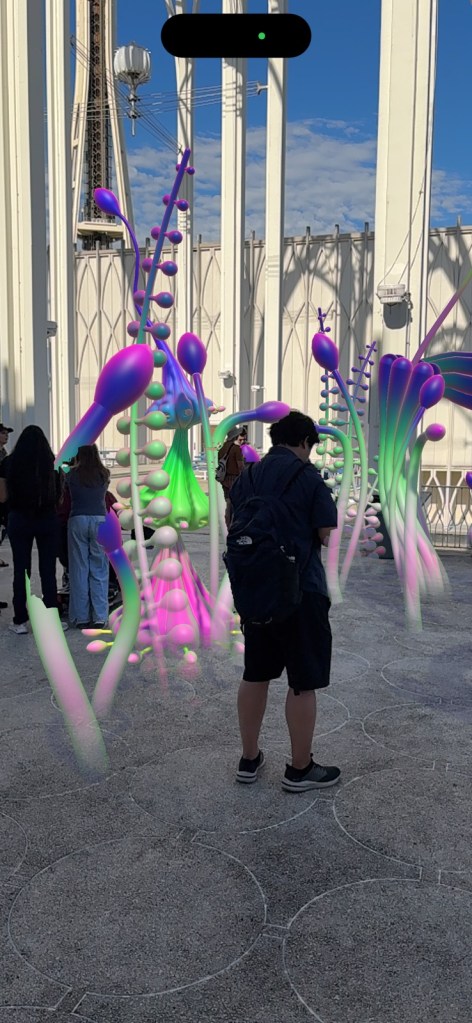
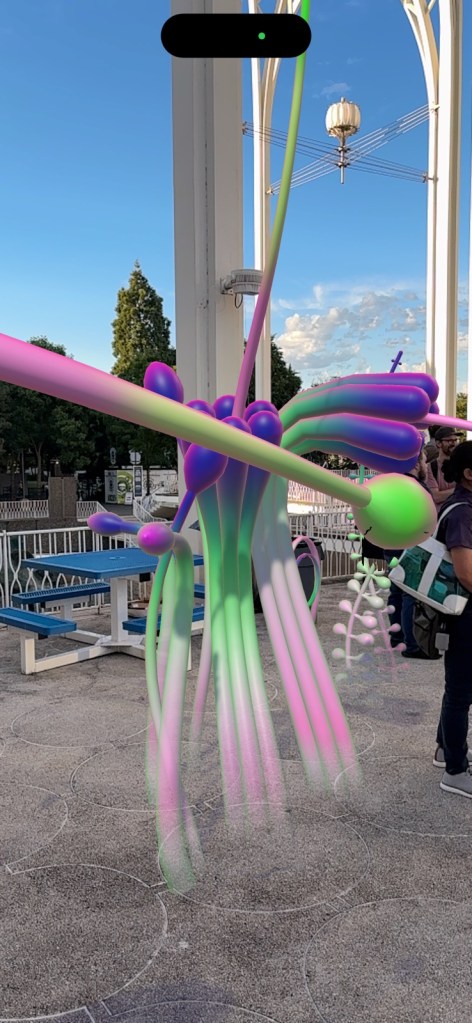
Latent Seas / Latencies is a striking digital installation that reflects the interconnected, cyclical ecosystem of the Puget Sound and Salish Sea watershed. Through morphing animations of kelp forests, marine life, and local birds, the artwork dissolves the rigid boundaries between land, water, and air. It effectively drops viewers into a speculative, multi-species environment where creatures constantly transform and shift orientations between the ground and sky.
The minds behind the installation possess uniquely complementary backgrounds. Alina Nazmeeva is a Chicago-based media artist and educator originally from Tatarstan, who serves as an assistant professor of computation at the UIUC School of Architecture. Her vast digital practice spans XR, gaming engines, CGI, and installations exploring the entanglements of digital and physical worlds.
Alex Kosnett, on the other hand, is an ecologist and urban planner living in Portland, Oregon, who designs trails and works to improve safe access to conservation lands in the Pacific Northwest. Kosnett’s work actively defies the false binary separating humans from nature. As a student of wildlife tracking and bird language, Kosnett aims to use VR and AR to expand human perception, guiding society toward a healthier, more entwined future with our “more-than-human kin.”
Below is our conversation with Kosnett on how their dual identities, cultural mythologies, and a shared passion for conservation shaped this ambitious new project.
Interview: A Conversation with Alex Kosnett
Shiriiazdanov: My understanding is that you grew up in Türkiye?
Alex Kosnett: I was born in Washington, D.C. My parents were diplomats, and my father met my mother in Türkiye. I grew up traveling around a lot—we lived in Japan for the first four years of my life, and then in the Netherlands and Iceland. But I grew up visiting my family in Türkiye often, and some of them later moved to the U.S. as well. I was just there two years ago. I’m a dual citizen.
Shiriiazdanov: So it’s fair to say that Türkiye is close to your heart?
Kosnett: Absolutely.
Shiriiazdanov: Does that show in your work?
Kosnett: I think so. A big part of the work we’re doing here is asking: What does it mean for people who are not native to this area to become part of the community in a healthy way? How can we learn to belong here?
Something we learned early in this project was that we could connect with some of the Native artists by sharing our own cultural stories. We started by sharing traditional Turkic myths with the group. I spoke about the Meander River, which has become a symbol for rivers flowing around the world. We wanted to relate that idea of people traveling along waterways to people coming here for the World Cup—everyone arriving, meeting the people who have always been here, and trying to find common understanding in their relationship to the land and water.
Shiriiazdanov: What drew you toward art, and specifically augmented reality?
Kosnett: I work with wildlife and birds. One of the exciting challenges is that when someone visits a place for just one day, how do they learn about the nature of a space that changes week to week or throughout the seasons? How do they see a forest grow or flowers bloom in a single visit?
With augmented reality, you can show a place changing over time. You can show people, places, and nature right in front of you. Or you can experience a place remotely and still find a meaningful connection.
For wildlife conservation, it’s especially helpful because you can help people feel closer to nature without disturbing sensitive habitats. Maybe it’s not safe for visitors, or maybe it’s not safe for the wildlife. If a protected area could be damaged by someone carrying invasive seeds on their shoes, we can still help them learn about that place without putting it at risk. Beyond that, augmented reality allows impossible things to happen right in front of us. We can have ghosts, fantastical plants, and magical elements in the city in a way that feels very different from simply looking at a picture.
Shiriiazdanov: I understand this isn’t your first AR project. I think you mentioned another one in your opening speech?
Kosnett: Yes. Alina and I first worked on a piece called Currents about four years ago for an event sponsored by Meta and Future Arts, using an augmented reality platform they had designed. That piece was about the salmon in this region, and we wanted to expand on those ideas and make something more developed. You could call this piece version 1.5.
Shiriiazdanov: Do you plan to continue working in AR exclusively?
Kosnett: Alina also works in virtual reality and textile art. She’s created really interesting pieces where she weaves textiles, and then when you put on a VR headset, entire scenes appear across the woven landscape, filled with insects and animals. She also designs beautiful industrial furniture and other objects.
I think augmented reality is exciting because it lets us do things that are physically impossible. But I also love the physical world. Much of my work centers around trail design, which is its own form of art—guiding people through an experience.
Shiriiazdanov: What was the most challenging part of creating this project?
Kosnett: We worked with some of the other artists to help realize their pieces. We used 3D scanners to digitize traditional objects—from salmon skin to cedar bark—to create digital assets. I was surprised by how difficult it was to scan cedar bark. It seemed like it would be very simple, but the scanners had trouble recognizing it in space. Sometimes it was actually easier to build something entirely from scratch. For Ash’s piece, Alina designed the beads from scratch in Blender, which turned out to be easier than scanning the real ones.
Another challenge was efficiency. People have to download the experience quickly, so the app has to stay very small while still looking expressive and interesting.
Shiriiazdanov: How did you meet Alina? What made you decide to work together?
Kosnett: I was roommates with her husband, John, at Virginia Tech. We met through a student group involved in environmental activism around the coal industry, advocating for clean air and clean water for communities near our school. A few years after graduation, John met Alina while they were both studying in Europe. John was at the top of his architecture class, and he immediately told me that Alina was much smarter, cooler, and better at the work than he was.
We all ended up living together in Massachusetts in 2019. They got married during the coronavirus lockdown, and I was the best man at their wedding. During the lockdown, we spent a lot of time visiting wildlife areas, beaches, and the ocean. We talked a lot about the kind of artwork, architecture, and conservation work we wanted to create. Later, when Future Arts contacted Alina about making a piece related to this project, I was already living in Portland. She reached out to me, and we started talking about salmon and the ecology of the Pacific Northwest. I’m very grateful that collaboration led to even more work together.
Shiriiazdanov: Since you share a similar cultural background, do you think that influenced your collaboration?
Kosnett: Definitely. We wanted to find common ground through our art and culture so we could have an honest conversation with people here. We’re both fairly skeptical people. We love history and tradition, but we also recognize that culture and tradition can sometimes be used to subjugate people. We wanted to find the truest way to talk about our culture—not just art for art’s sake, but art for community, art for the Earth, and something meaningful that connects with our ancestors. If it were simply for show, it wouldn’t feel meaningful, and that would be disrespectful.
When we first gathered, everyone exchanged gifts. Members of the Native cohort shared salmon eggs, huckleberries, and jewelry. In return, we brought olive bread, smoked fish, honey, nuts, dried apricots, teas, and other foods from our own culture. Of course, it’s very different from sharing medicines you’ve gathered yourself from your homeland. But even so, finding ways to make those connections real meant a great deal.
Shiriiazdanov: How did you divide the work on this project? Alina has more of the technical background?
Kosnett: Yes, she’s the original programmer and digital sculptor. For this project, I learned some of those skills as well so I could help create assets for the other artists. She procedurally coded the landscape for our piece.
On my end, I have a 3D microphone, so I went out and recorded sounds in natural areas. In our piece, you can hear native birds and flowing water recorded from places where I work.
Shiriiazdanov: I didn’t realize those were real recordings.
Kosnett: It takes a moment. The experience starts with chimes, and then you begin to hear Swainson’s thrushes, crows, robins, and several species of warblers singing in the background. It was fun to create.
Shiriiazdanov: How long did it take to create the installation?
Kosnett: We started in March. We came here in person, saw the site, and began brainstorming. Alina was very interested in early transcendental art, and we wanted to incorporate the arches into the piece so they resembled kelp forests. The project really had to begin once we could experience the space ourselves.
We’ve been working almost constantly for the past four months—late nights in Blender and Unity, while collaborating with José and the Future Arts team. Four months is actually pretty fast. We’ll probably continue making some refinements throughout the summer.
Shiriiazdanov: What’s been the best part of this whole project for you?
Kosnett: Learning new skills. Finally having an excuse to force myself to learn Blender has been wonderful. I’ve been a 2D artist for a long time—I’ve worked in Illustrator and Procreate, and I love landscape painting. Being able to sculpt something in 3D that people can actually walk around is incredibly exciting. I know I want to keep making new things with that ability. It has really opened my eyes to new possibilities.
Shiriiazdanov: Thank you so much for talking with me today!
Kosnett: It’s been really exciting. I’m so glad there’s a Turkic community that we get to be a part of. Sometimes it feels like we’re alone in such a diverse place that’s full of so many other cultures that may be more organized. But I think there’s so much potential for a community here, and I’m really glad we get to connect.
Future Arts Way is currently open to the public. For interactive trial locations, maps, and smartphone instructions, visit the official Future Arts website at https://www.futurearts.co/futureartsway.
The photographs below were taken by Marsel Shiriiazdanov while experiencing the AR trail, capturing how the artwork comes to life through a smartphone screen.